The internet is supported by undersea cables, which provide over 95 percent of the information in the world, even when we pass across oceans. These cables are the lifelines of connection in the Gulf, connecting continents and driving digital transformation. As firms, such as du, take the lead in huge infrastructural undertakings, the UAE is rapidly emerging as a data hub and a next-generation connectivity gateway.
Beneath the Waves: How Subsea Cables Power Global Connectivity and the Gulf’s Digital Future
The Invisible Web Beneath the Waves
When most people think of the internet, they imagine satellites orbiting the Earth or massive data centres filled with humming servers. In reality, the digital world runs beneath the ocean surface, a vast network of undersea cables connecting continents, economies, and people.
These undersea cables form the invisible fabric of modern life, supporting everything from video calls and online banking to AI-powered cloud computing. They carry over 95% of international data, proving that our world is connected more by oceans than by skies.
The Gulf region, with countries such as the UAE as its pioneers, is turning out to be a strategic nexus in the heart of this global network. As the du takes a leading position in Dubai, the region is becoming more than a telecom hub in the region to become an important world digital corridor.
The Backbone of Global Connectivity
Within each second, massive volumes of data pass along thousands of fibre-optic strands in the sea, lying in silence on the ocean floor. These submarine cables transfer information at almost the speed of light, connecting billions of users worldwide.
An individual sea cable, the size of a garden hose, is capable of supporting hundreds of terabits of information per second, which is enough to stream several million high-resolution videos at the same time. Collectively, one and a half million kilometres of underwater cables connect the world, forming an unseen, but essential global nervous system.
This network keeps increasing as the global data needs increase. Indeed, over the past ten years, there has been a greater number of subsea cables in operation than in the preceding 4-decade history combined – an indicator of the importance of the infrastructure.
Inside the Technology of Subsea Cables
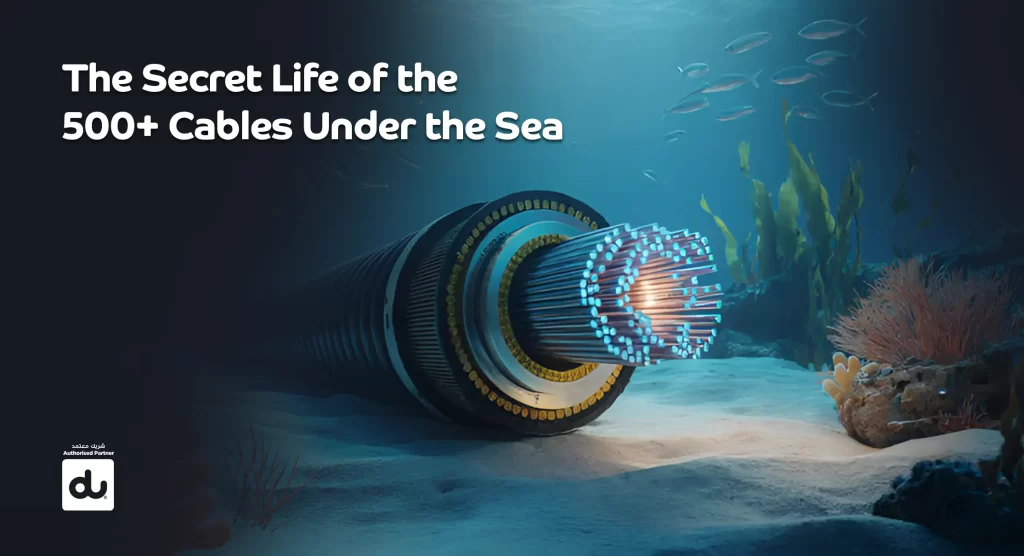
An internet cable in sea may seem straightforward, but what lies under the protective layers is precision engineering. Light pulses are carried through the core by ultra-thin glass fibres, which carry bits of data across oceans. The core is protected by layers of copper, steel, and insulation to withstand extreme underwater pressure and prevent damage from fishing trawlers or anchors.
Specialised ships deploy the cables along pre-mapped routes on the ocean floor, sometimes at depths of up to 8,000 meters. Onshore landing stations then connect the undersea cables to terrestrial networks, distributing data to cities and users.
The result? Fluid connectivity that is instantly felt whether you are streaming in Dubai, doing business in London, or holding a virtual meeting in Singapore.
The Gulf’s Strategic Role in Global Data Routes
The Gulf region is no longer merely an energy hub, it has become a digital crossroad. It lies in the middle of Europe, Africa and Asia and thus makes it a natural intersection of major subsea cable systems.
The sea cables in Gulf are now used as a conduit in connecting routes of data between East and West due to the developed telecommunication infrastructure and global orientation of the UAE. This has made such cities as Dubai to become important exchange points as far as international connectivity is concerned.
With the rapid pace of digital transformation, demand in the regions for bandwidth, cloud computing, and edge data centres is skyrocketing. Telecom innovators such as du come in at that point, so the infrastructure of the region is not only suitable to the existing requirements but also to the potential ones.
How du Strengths UAE’s Digital Backbone
Du, a leading telecom provider in the UAE, has helped establish the country’s position in global connectivity. Through strategic alliances and investments in subsea cable networks, du ensures businesses and customers enjoy uninterrupted high-speed access to worldwide data networks. Its advanced corporate internet packages further empower enterprises with reliable, secure, and scalable connectivity solutions that support seamless global operations.
Through the use of global cable consortiums and landing on UAE beaches, du contributes to making the region more data resilient, which means that in the event of failures, the region will have constant protection, and the global businesses working in the Gulf territory will be connected without any issues.
Besides, du does not just deal with infrastructure. It is promoting innovations in cloud services, Internet of Things connectivity, and network management via AI, which is backed up by the powerful underwater cable infrastructure on which it is based its digital ecosystem.
Challenges Beneath the Sea: Maintenance and Resilience
Undersea cables face challenges despite advanced technology. Natural phenomena like earthquakes, accidental damage from ship anchors, and even shark bites can disrupt global data flow.
The process of repairing a subsea cable is complicated and requires a specialised ship, remotely operated vehicles (ROVs), and professional engineers who locate, retrieve and suture the damaged parts of the cable – usually under harsh conditions.
This is the reason why telecom companies such as du invest a lot in backup routes, and in case one route is damaged, then data automatically diverts through the other routes. Such resilience is important in ensuring that digital communications are not disrupted, particularly in financial institutions, cloud providers and other critical infrastructure that demand 24/7 uptime.
Sustainability and the Future of Subsea Networks
Sustainability is emerging as the leading focus in the development of subsea infrastructure, as the world is fast becoming increasingly green. New generations of undersea cables are being developed to have less impact on the environment, employing energy-efficient amplifiers and other environmentally friendly materials which have minimal interference with marine life.
Environmental care is a part of infrastructure growth in the Gulf, du internet and its customers are factoring in sustainability concepts in all their network development work – whether it is cautious routing or energy-saving landing stations.
In the future, AI, 5G, and edge computing may bring the position of undersea networks to a new stage. The optimisation of data flow will be driven by smart algorithms operating in real time to minimise latency and enhance energy efficiency. With advanced infrastructure and innovative du home internet plans, this development positions the UAE and du as pioneers in creating a truly sustainable digital future.
A Window into the Future: Expanding Horizons
New technologies such as quantum computing and metaverse applications will impose an exponentially larger data capacity. Submarine network infrastructure today should therefore transform itself into a smart, adaptable environment.
The UAE is putting a lot of investment into digital connectivity projects, which are in line with the national vision of innovation and a smart economy. Du is going to be included as well, and therefore both business and consumer would be enjoying the most up-to-date connectivity energies that match the global standards.
This is not just an offer of bandwidth, but empowerment. It implies providing the region with tools, infrastructure and reliability that would allow it to succeed in a digital-first world.
Conclusion: The Deep Connection Powering Tomorrow
All emails, all cloud files move, all online transactions are based on a cable somewhere beneath the waves. Although these internet cables in the sea are not visible, they are the ones that run almost all the things in the contemporary world.
This system of underwater cables is not a piece of infrastructure, but the sea cables in Gulf are the base of the change of this area into an interconnected, inventive and stable digital centre.
As companies such as du are on the frontline, the UAE is becoming even stronger as an agent of connection between continents and as a pioneer in next-generation connectivity. Beneath the blue waters lies a force shaping our shared digital future one fibre, one pulse of light, one connection at a time.